

Parking Lot Striping & Line Marking for Commercial Lots
Every driver reads your parking lot before they read a single sign. Faded lines end that conversation. We stripe and re-stripe commercial lots across Kissimmee and Central Florida so the layout does its job: traffic moves, pedestrians stay protected, and more cars fit the same footprint. We work to recognized stall dimensions and the FHWA MUTCD color convention, in durable reflective traffic paint that bonds to asphalt and holds up to Florida sun.
What Does a Stripe Job That Lasts Take?
Paint goes down last. The prep and layout come first. A stripe job holds up when the layout meets the standards a driver, an inspector and a fire marshal all read the same way.
- Correctly sized lines: the FHWA MUTCD sets a 4-inch standard for stall and lane lines, with wider markings where they carry more weight. Stop bars run 12 to 24 inches, and crosswalk lines 6 to 24 inches with the crosswalk itself at least 6 feet across.
- The MUTCD color convention: white for stall lines and crosswalks, yellow for no-parking and curb zones, blue for accessible spaces. It is a national standard, so a driver reads your lot the way they read the road.
- Clear fire lanes: fire apparatus access lanes stay unobstructed to at least 20 feet of width and 13 feet 6 inches of vertical clearance, marked and lettered to the local fire code.
- Purpose-made traffic paint: a durable, reflective coating formulated to bond to asphalt, where an ordinary acrylic or latex would peel. We match a water-based or solvent-based paint to the surface and the weather.
- A layout that flows: stalls, aisles and accessible spaces set to recognized dimensions, with stencils for arrows, accessibility symbols and word legends.
Accessible stalls carry federal rules that go past color. If yours need to be sized and counted correctly, that is our ADA compliant striping. And the best time to stripe is right after a sealcoat, when the surface is a clean black canvas and fresh lines land sharp. Request a striping quote and we will lay out a lot that flows.
Our Striping Process, Step by Step
- We sweep or power-wash the surface to lift off dirt, debris and vegetation, and fill any cracks or potholes before a drop of paint goes down. A clean surface is what lets the paint bond.
- We let the lot dry fully. Moisture trapped under the paint stops it from adhering, so we wait the surface out rather than fight it.
- We lay out stalls, aisles and accessible spaces with chalk lines or tape to recognized dimensions, so the plan is confirmed before it is permanent.
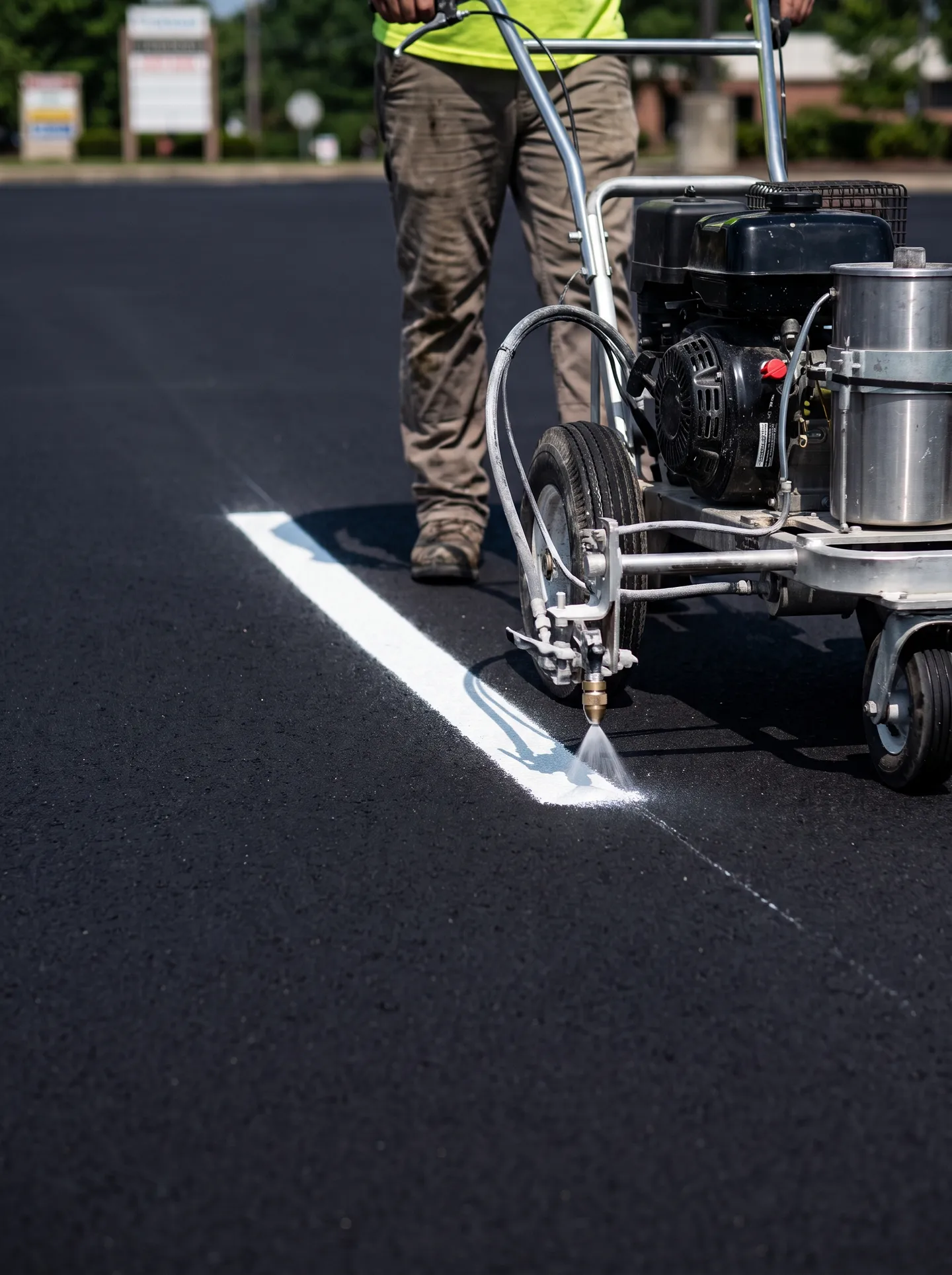
- We spray the paint on with an airless machine, working a dry window between 45 and 85°F so it sets before it can lift.
- We add the stencils and legends the lot needs: accessibility symbols, directional arrows, fire-lane and no-parking markings, and word legends like STOP or ONLY.
What We Use
- Airless machines and cut stencils: airless striping machines and bucket-fed sprayers lay a clean, consistent line, and cut stencils keep every arrow, symbol and legend identical from one end of the lot to the other.
- Reflective traffic paint: the reflective finish comes from tiny glass beads carried in the paint that bounce headlights back to drivers after dark, which is what keeps a lot readable at night as well as at noon.
What Goes Wrong Without It
- Faded lines: striping you cannot read at dusk confuses traffic flow, and a lot that directs cars poorly carries real liability.
- Paint failure: stripe over a wet or dirty surface and the paint lifts within weeks, so the whole job has to be redone.
- Missing accessible markings: non-compliant or absent accessible-stall markings fail inspection and expose you to a claim, which is why we hold them to the ADA standards.
What Central Florida Does to a Fresh Stripe Job
Central Florida works against paint harder than most states. The sun fades traffic paint faster than it does in cooler climates, so lines that would read for years up north go dull here sooner. Summer afternoons bring downpours that lift paint off a surface that is not fully dry, which is why we watch the weather window and stripe onto dry pavement. And on the high-turnover retail and tourist corridors around US-192 and Vine Street, constant tire traffic scrubs lines thinner by the season. Plan on restriping sooner here than a national average would suggest, and on the busiest tourist-corridor lots expect the accessibility symbols and directional arrows to wear first, since that is where tires turn hardest.
Striping Guides
- How Often Should You Restripe a Commercial Parking Lot?
- Parking Lot Striping Cost Per Space
- Thermoplastic vs. Paint Striping
- Angled vs. 90-Degree Parking Stalls
- Parking Lot Traffic Flow & Aisle Design

Parking Lot Striping FAQs
A standard passenger stall is 9 feet wide by 18 feet long. Compact stalls run about 8 by 16 and must be labeled "Compact Only." Two-way drive aisles are about 24 feet wide; one-way aisles 12 to 15.
Every 18 to 24 months for most commercial lots, and sooner under Central Florida sun or on a high-traffic site. See how often to restripe.
White marks stall lines and crosswalks, yellow marks no-parking and curb zones, blue marks accessible spaces, and red commonly marks fire lanes under the local fire code. Because the MUTCD is a federal standard, those colors mean the same thing in every state.
Paint costs less and lasts one to two years. Thermoplastic costs more but lasts five to eight and reflects headlights. See our thermoplastic vs. paint guide.
Yes. We size, count and mark accessible stalls, access aisles and signage to the 2010 ADA Standards under ADA compliant striping.
Dry pavement and air between 45 and 85°F. We time the work around Central Florida's afternoon storms, and because water-based traffic paint dries fast in warm, dry conditions, most lots reopen the same day.
Over dust or moisture, fresh paint peels or tracks within weeks, so we sweep or power-wash and let the lot dry first. Where an old layout is changing, we black out or grind off the conflicting lines so drivers are never reading two layouts at once.
Angled layouts at 45 or 60 degrees can improve traffic flow in high-turnover retail lots, though the right layout depends on your aisle widths and site. See angled vs. 90-degree stalls.
It depends on the lot size, the layout, and whether stencils and accessible stalls are involved, so we quote it per lot rather than guess. See striping cost per space.