Angled vs. 90° Parking Stalls: Which Layout Fits Your Lot?
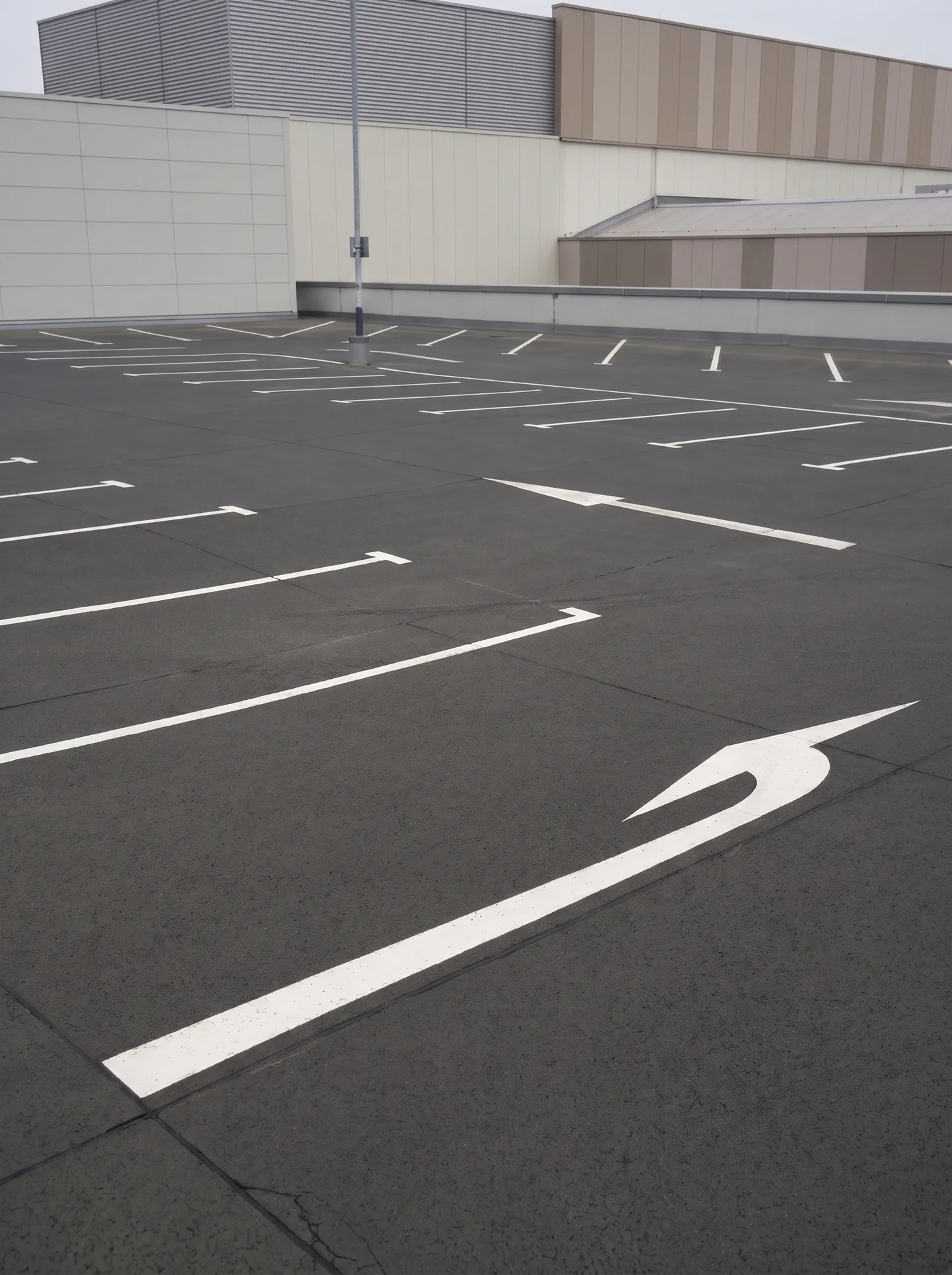
When a lot gets restriped or laid out fresh, stall angle is one of the few choices that changes both how many cars fit and how safely traffic moves. It comes down to 90-degree (perpendicular) stalls versus angled stalls at 45 or 60 degrees. Each carries a clear trade-off.
90-Degree (Perpendicular) Stalls
Perpendicular stalls, about 9 feet wide, pair with a two-way drive aisle of roughly 24 feet. They pack the most cars into a given area and let drivers approach from either direction. That is why they suit grocery, big-box and medical lots, where capacity and two-way flow matter most. The trade-off: backing into and out of a 90-degree stall takes more maneuvering, which can slow a busy aisle.
Angled Stalls (45° or 60°)
Angled stalls turn the parking to 45 or 60 degrees and run one-way aisles, roughly 14 feet for a 45-degree layout and 18 feet for 60-degree. Drivers enter with a gentle turn at low speed, so parking is quicker and cars clear the aisle faster, and the one-way flow cuts head-on conflicts. The cost is capacity: angled layouts fit fewer cars than perpendicular, and backing out into one-way traffic takes care.
How Do You Choose?
- Maximize capacity: choose 90-degree stalls with two-way aisles when every space counts and the lot has room for wider aisles.
- Prioritize flow and turnover: choose angled stalls with one-way aisles for high-turnover retail, quick-serve and drive-through-heavy lots, where easy in-and-out speeds everything up.
- Work within the lot you have: narrow or oddly shaped lots often stripe more efficiently at an angle, while large rectangular lots favor perpendicular rows.
Either way, the layout has to keep the circulation logical and hold the required ADA accessible stalls on the shortest route to the entrance. We lay out and stripe lots to fit the site and its traffic. Request a striping quote and we will map a layout that flows.
Stall Width Is a Separate Call
Angle sets the aisle; turnover sets the stall width. The Urban Land Institute and the National Parking Association put a standard stall at 9 feet wide for moderate-to-high-turnover lots, where drivers come and go all day and need room to open a door beside a neighbor, and allow 8 feet 6 inches at low-turnover sites like long-stay employee or reserved lots. Wider stalls cost a few spaces per row, but they cut door dings and crooked parking in a busy retail lot, so we set the width to how the lot actually gets used rather than to a single default.
ADA Stalls Come First, Whatever the Angle
Stall angle is a capacity-and-flow decision. It does not change your federal accessibility obligations. Either layout still owes the accessible-stall count from the 2010 ADA Standards table, at least one van-accessible space for every six accessible spaces, and stalls placed on the shortest accessible route to the entrance. Accessible stalls stay 96 inches wide with a 60-inch access aisle, held under the 1:48 slope limit. We lay those in first, then fit the standard rows and aisles around them. See our ADA compliance guide for the full table.
Reangling a Lot Is a Full Layout, Not a Reline
Switching a lot from perpendicular to angled, or the reverse, is a fresh layout, so it costs more than a simple reline of the existing stalls. We measure and chalk every line to the new geometry rather than repaint over the old one. Because the change lays down a whole new set of markings, the efficient time to do it is right after a sealcoat, when the old lines are covered and the surface is a clean canvas. Weigh the capacity you gain or give up before committing, since the angle sets how many cars the same footprint holds.
Common Questions
- How much parking do I give up going angled? It depends on the angle. A 45-degree layout parks more cars per square foot than 60 degrees, and both trail a 90-degree double-loaded row, which packs the most stalls into a given acre. Narrower one-way aisles claw some of that back on a tight site.
- How wide should my standard stalls be? Nine feet for a moderate-to-high-turnover retail or medical lot, and 8 feet 6 inches is acceptable at low-turnover employee or reserved lots, following Urban Land Institute and National Parking Association guidance.
- Can a small or odd-shaped lot use angled parking? Often it should. A 45-degree layout runs a one-way aisle as narrow as 13 to 15 feet against the 24 feet a two-way perpendicular aisle needs, so an angle frequently fits rows into a width perpendicular parking cannot.
- Why do angled stalls feel easier to park in? Drivers enter with a gentle, low-speed turn instead of swinging in square, which shortens the maneuver and eases the tight backing that causes side-swipes and door dings.
Related Guides
- Parking Lot Traffic Flow: Circulation & Drive-Aisle Design
- Central Florida ADA Parking Lot Compliance: Requirements & Dimensions
- All resource guides