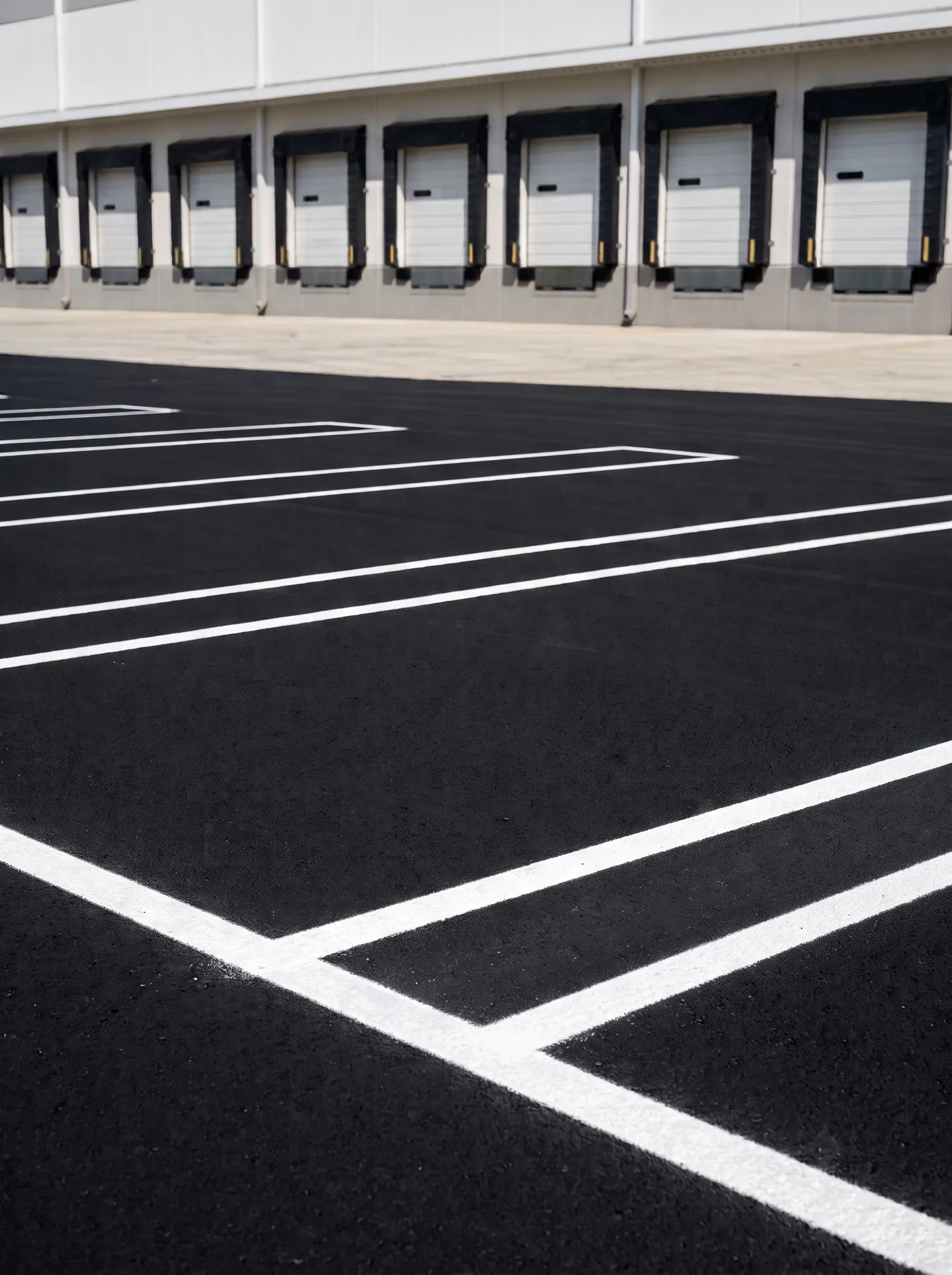
Commercial Parking Lot Striping in Sanford, FL
Sanford is the load-bearing end of Seminole County. The Orlando Sanford International Airport area anchors a growing base of warehouse and distribution lots that take truck and trailer weight, while the brick-paver historic downtown and the US 17-92 retail corridor add their own demands. One lot needs markings built for heavy trucks. The next needs a light touch in a historic district. We handle both, across Sanford.
Why Do Sanford Lots Need a Local Approach?
Three forces set the terms in Sanford: industrial axle loads, a riverfront water table, and a historic core. Each one changes how a lot has to be marked and maintained:
- Heavy truck and trailer loads: warehouse and distribution lots near the airport carry axle weights that scuff striping and grind sealcoat thin at truck routes, aprons and dock approaches. Those spots need the most frequent refresh.
- Riverfront water table: low ground and a high water table near Lake Monroe and the St. Johns River keep the subgrade under downtown and riverfront lots wet. That opens cracks and depressions, and we patch them before a clean restripe will hold.
- Wet-season ponding: summer afternoon thunderstorms leave standing water on flat, large-footprint lots. It lifts fresh paint and speeds potholing wherever the drainage runs weak.
- Sun and UV: Central Florida heat and hard UV oxidize sealcoat and fade traffic paint faster than a northern climate does. The surface protection and the lines both need a shorter cycle.
- Historic-downtown context: the First Street and Sanford Avenue brick-paver streetscape calls for markings that respect the historic district and work within tight on-street access.
- Retail and mall turnover: high-turnover parking near the US 17-92 corridor and the Seminole Towne Center district concentrates wear in the drive aisles. That is where stall lines and accessible markings fade first and where a lot loses its clear traffic flow.
- Sandy, weak-bearing subgrade: the sandy Central Florida soils under these lots give weak support, so base prep matters most on the industrial and heavy-traffic sites. Skip it and the surface settles no matter how fresh the lines are.
Striping Built for Heavy-Duty Lots
A warehouse apron asks for a different kind of marking than a storefront lot. We lay durable striping for truck routes, loading zones and fire lanes, then back it with sealcoating and crack repair built for that weight. The lines and the surface hold instead of wearing off in a season. We scope every job to the traffic the lot actually carries, from a distribution yard to a retail frontage.
Durable striping starts with a clean, dry surface. We sweep or power-wash the lot, seal the cracks, and lay crisp 4-inch lines in purpose-made traffic paint with an airless machine, in dry weather between 45 and 85 degrees. Stalls go down at 9 by 18 feet, two-way drive aisles at about 24 feet so a trailer can swing through, and fire lanes and dock zones get stenciled under the MUTCD color convention: white for stalls, yellow for no-parking, blue for accessible. On a multi-lot operator with warehouse and retail sites across the city, a pavement management program puts every lot on one inspection and treatment schedule instead of waiting for each to fail.
What We Stripe Across Sanford's Property Types
Sanford runs on several kinds of commercial lot, and each one wears and gets marked differently. Here is how our work maps to them:
- Warehouse and distribution yards: near the airport and the Amtrak Auto Train terminus, trailers stage, turn and dock all day. We keep the truck lanes and dock aprons marked and patched to carry that axle weight, the kind of load a storefront lot never sees.
- Waterfront and civic lots: along the Lake Monroe riverfront, from Fort Mellon Park to the downtown marina and the Sanford Riverwalk trailheads, public turnover stays high and the water table sits close under the base. We keep those lots draining through catch-basin repair, with ADA curb ramps where the walkways meet the pavement.
- Historic and neighborhood cores: the First Street and Sanford Avenue brick-paver core and the older Goldsboro and Mellonville districts carry tight access and a streetscape worth protecting, so we keep the markings clean and in step with the district.
- Campus and institutional lots: the large visitor and commuter lots near Seminole State College and the SunRail station fill and empty in waves. Clear stall lines and accessible spaces counted through ADA-compliant striping keep those surges orderly.
Commercial Corridors We Serve in Sanford
- Orlando Sanford International Airport area: warehouse, distribution and industrial-employment lots
- US 17-92 (French Avenue): the retail and commercial corridor
- Seminole Towne Center district: the mall and surrounding retail area near I-4
- Historic Downtown: the First Street and Sanford Avenue brick-paver commercial core
- The I-4 and SR 417 corridors: eastern Seminole County commercial frontage
Maintenance for Industrial and Retail Lots Alike
Heavy-use lots fail fastest when small problems sit. Crack sealing, sealcoating and prompt patching protect warehouse aprons and retail fronts alike, and push the bigger repairs further out. The intervals are steady here: sealcoat a commercial lot every two to three years, restripe roughly every 18 to 24 months, and seal cracks the week they open, since a proper seal keeps water out of the base for three to eight years. In Sanford's heat and wet season, staying near the short end of those windows pays off.
Watch for a few tells between visits, and call early when you see them:
- Lines you cannot read at dusk: faded stall and aisle markings raise liability and confuse traffic flow. It is time to restripe.
- A dull, graying surface: oxidized asphalt turns gray and brittle and starts to ravel. That is the sealcoat calling for a refresh.
- Standing water after a storm: birdbaths that linger mean the slope or a catch basin is failing, and the ponding works into the base.
- Cracks wider than a pencil: open cracks let water reach the base and become potholes. Sealed early, they stay cheap to fix.
See the best time of year to sealcoat, then request a free quote for your Sanford property.
Request a Free Quote