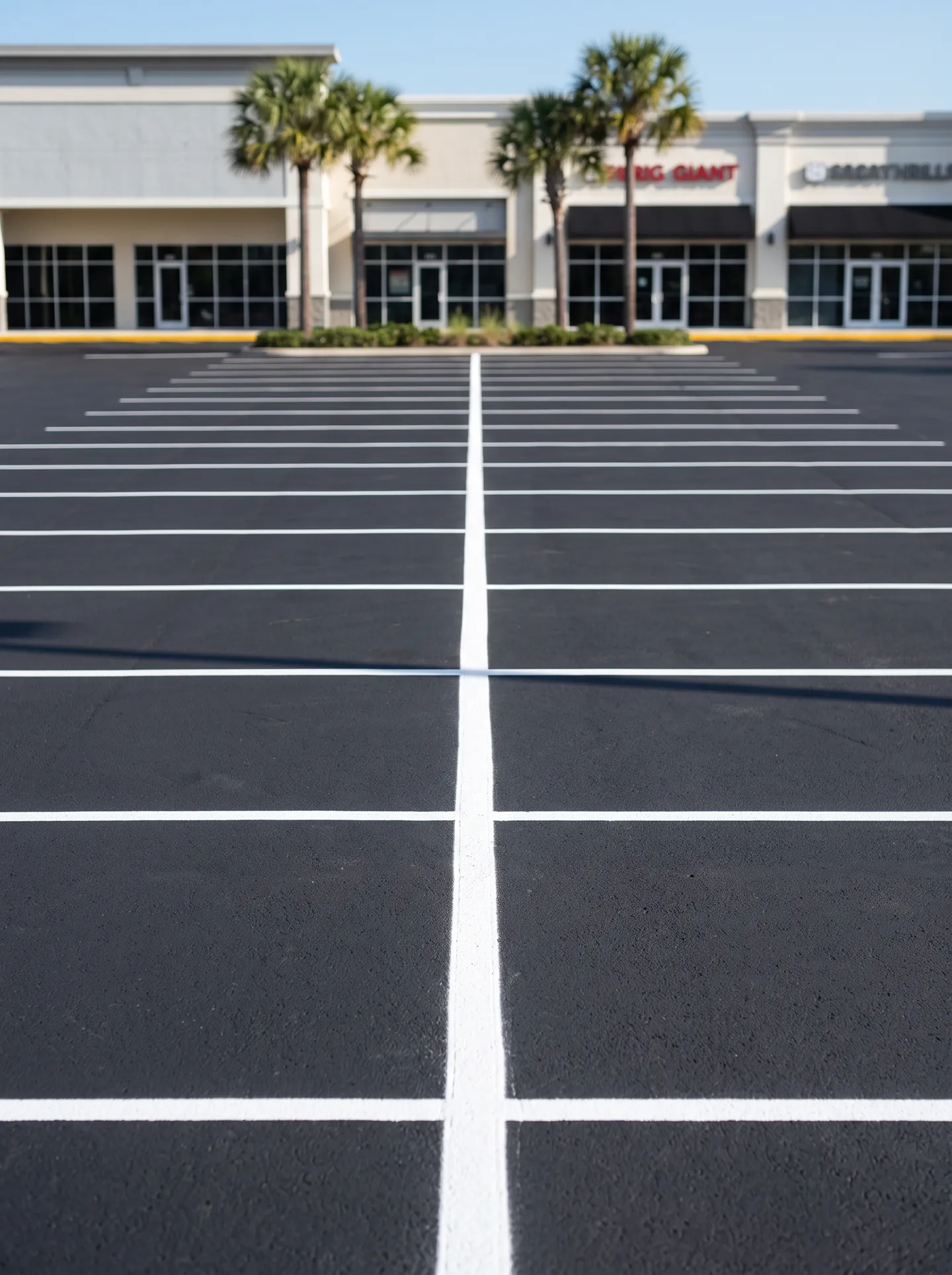
Commercial Parking Lot Striping in Kissimmee, FL
Kissimmee runs on its commercial corridors. The US-192 / Vine Street CRA alone holds roughly 1,064 acres of non-residential land and about 6 million square feet of commercial space, from the western tourist corridor east to the Valencia College area. Those lots take a punishing load: constant turnover, heavy tour-bus, RV and delivery traffic, and full Central Florida heat. It wears striping and sealcoat far faster than a quiet suburban lot. That is the lot we are built for. We stripe, seal, mark and maintain high-turnover commercial lots across Kissimmee and Osceola County.
Why Do Kissimmee Lots Need a Local Approach?
Three things shape how a lot's markings age here: the corridor traffic, the climate, and the ground under it. A generic spec misses the failure points that actually shorten their life in this city.
- Heavy tourist-corridor loads: high-turnover lots along US-192 and Vine Street carry constant traffic plus tour-bus, RV and delivery weight. It scuffs and fades striping and grinds down sealcoat faster than a typical lot, and the drive lanes and entrances lose their lines first.
- Intense UV and summer heat: prolonged Central Florida sun fades traffic paint and oxidizes sealcoat on large, fully-exposed lots. Both the lines and the surface protection need a shorter refresh cycle than the national norm.
- Heavy summer downpours on flat ground: seven to nine inches of rain a month from June through August, over low ground near Lake Tohopekaliga and the Shingle Creek wetlands. Water ponds, lifts fresh paint, degrades sealcoat, and calls for drainage correction wherever slope is weak.
- Sandy, high-water-table subgrade: flat, sandy ground and a high water table drive settling, depressions and edge cracks. Those get patched before a clean restripe will actually hold.
- Corridors mid-redevelopment: both the Vine Street / US-192 CRA and the downtown US 17/92 core run grant and incentive programs to restore commercial frontage. Aging lots inside those districts need restriping, ADA re-layout and resealing to meet redevelopment standards, and stormwater and drainage sit high on the permit checklist given how close the ground is to the lake and wetlands.
- Hurricane-season stress: wind, debris and flooding wear markings and sealcoat every season, on top of the ordinary wet-season toll.
What We Do for Kissimmee Commercial Lots
We handle the marking and maintenance side of a commercial lot, scoped for how hard Kissimmee uses it.
- Traffic-flow striping and layout: crisp 4-inch re-striping, stencils, arrows and fire lanes built to hold up to bus, RV and delivery turnover along the corridors.
- ADA compliance: accessible stalls, access aisles and signage sized and counted to the 2010 ADA Standards for high-traffic retail and tourist lots, via ADA compliant striping.
- Sealcoating and crack sealing: sealcoating and crack sealing that counter the UV, heat and water that age Kissimmee pavement fastest, and reset the surface for fresh lines.
- Repair and drainage: pothole patching and catch-basin repair for the ponding that flat, sandy corridors invite. Water reaching the base is where most pavement failure starts, so a full-depth patch cuts a square edge at least a foot into sound pavement and backfills in compacted lifts.
- Concrete and ADA ramps: sidewalks, curbs and curb ramps built to accessible-route geometry, a 1:12 maximum ramp slope, a 36-inch minimum clear width, and truncated-dome detectable warnings where a ramp meets the drive lane.
- Managed maintenance for multi-site owners: for a corridor portfolio or an HOA community, a pavement management plan inventories every lot, surveys condition each year, and ranks the work by cost-effectiveness so nothing turns into a surprise reconstruction bill.
What Kind of Kissimmee Lots Do We Work On?
As the county seat and commercial hub of Osceola County, Kissimmee packs roughly 3,685 people per square mile into a dense commercial grid, and its economy leans heavily on retail, tourism and service, all parking-intensive uses. The lot out front carries a different job for each. Here is how the work changes by property type.
- Tourist-corridor retail and hospitality: these lots fill and empty all day and share their aprons with tour buses and RVs. Angled 45 or 60 degree stall layouts move that turnover through faster, and marked oversized bays keep buses and RVs out of the standard stall grid.
- Downtown storefront lots: the US 17/92 core along Main, Broadway and Emmett Streets wants crisp 4-inch lines and clean edges that suit a redeveloping district. We phase the work so the storefront stays open and reachable while we mark it.
- Civic and event venues: the high-volume lots near the Osceola Heritage Park complex and the Valencia College campus fill and empty in waves. Clear directional arrows, fire lanes and marked accessible routes keep large crowds moving and keep the lot compliant.
- HOA and community lots: for Osceola County's dense residential communities, we maintain private parking areas, sidewalks and drive lanes through HOA lot maintenance on a reserve-minded schedule, since private roads are rarely built to DOT standard and need planned upkeep.
Commercial Corridors We Serve in Kissimmee
We stripe and maintain lots across the city's commercial districts and corridors:
- US-192 / Vine Street CRA: the primary east-west tourist-commercial corridor
- Downtown Kissimmee CRA: the US 17/92 core along Main, Broadway and Emmett Streets
- John Young Parkway and Osceola Parkway: north-south commercial corridors feeding the tourist strip
- Florida's Turnpike and Interstate 4: the regional interchanges that funnel traffic onto Kissimmee's commercial lots
How Often Do Kissimmee Lots Need Attention?
Watch for the tells between visits: lines you cannot read at dusk, a dull accessibility symbol, ponding that lingers a day after the rain, and cracks wider than a pencil. Crack sealing at that stage holds for three to eight years and keeps water out of the base. On the ADA side, the federal count scales with lot size, one accessible stall at 25 spaces on up, with at least one van-accessible space for every six, and we verify it on every restripe.
Florida heat and traffic push the intervals shorter than the national norm. Sealcoat every two to three years, restripe roughly every 18 to 24 months, and seal cracks the week they open. Not sure where your lot stands? Our guide on the best time of year to sealcoat in Central Florida walks through the timing. Request a free quote and we will assess your Kissimmee lot and build a schedule around how it actually gets used.
Request a Free Quote