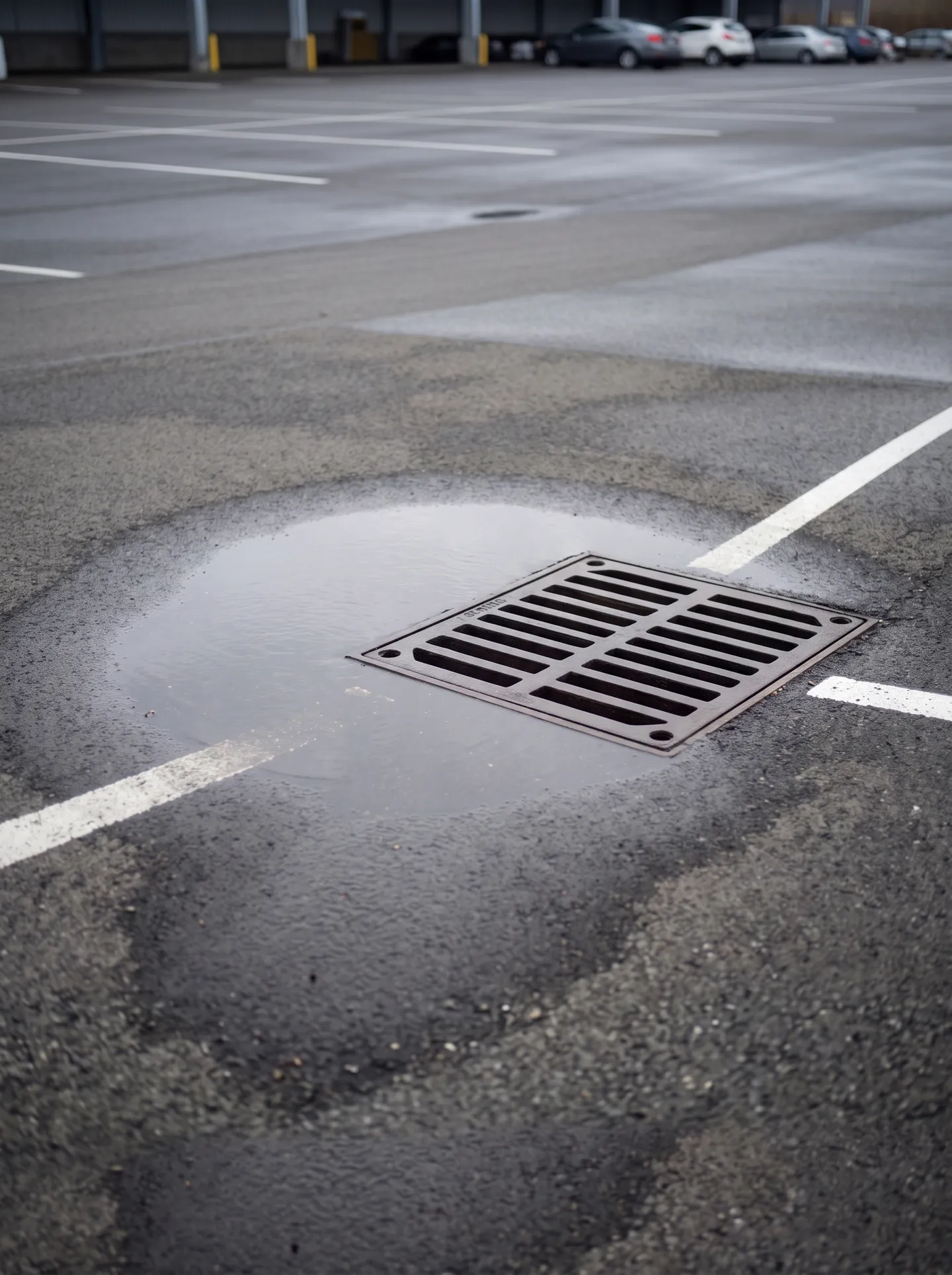
Fixing Standing Water: How to Resolve Parking Lot Drainage Problems
Standing water is more than an eyesore. Every puddle that lingers after a storm is working its way into the asphalt and softening the base beneath it, so a drainage problem ignored today becomes a pavement bill tomorrow. The good news: most ponding can be corrected at the source without tearing up the whole lot.
Why Do Parking Lots Pool Water?
- Base settling: the ground under a section settles and leaves a low spot, or birdbath, that collects water after every rain.
- Improper slope: the lot was never graded to carry water toward a drain, so it sits where it lands.
- Blocked or poorly located catch basins: sand, rock and trash choke the drainpipe, or there was never a basin where the water actually collects.
- An overlay that trapped water: a previous overlay laid without milling raised the surface and changed the way the whole lot drains.
Fixes That Don't Require a Full Tear-Out
- Catch-basin repair: we restore a failing basin with a concrete-ring replacement, a top-half rebuild, or a full rebuild, matched to how far gone it is.
- Trench drains: a narrow linear drain gathers water across a wide area and routes it to the storm system, ideal at entrances, loading docks and garage doors.
- Relief basins and swales: a relief basin, or a rip-rap swale with buried 4-inch slotted pipe, redirects water with only shallow trenching.
- Targeted regrading: reworking just the problem area to restore proper slope back toward the drain.
We diagnose why a lot ponds before we touch it, then correct the cause under drainage and catch basin repair. Once the water is moving off the lot, we follow up with patching and sealcoating to protect the surface. Request a drainage assessment.
How Much Slope a Lot Needs to Shed Water
Drainage starts with grade. Asphalt design guidance calls for a minimum slope of about 1 percent so water keeps moving, and parking areas are commonly graded to roughly 2 percent, which works out to about a quarter inch of fall per foot. There is a reason lots are not built flatter: a cross slope under 2 percent is difficult to construct without leaving birdbaths, the shallow depressions where water pools. When we read ponding on a lot, the first question is whether the surface ever had the slope to drain, because that tells us whether the answer is regrading or a new drain to catch water the grade cannot carry.
Why Standing Water Is a Pavement Problem, Not a Puddle
A puddle looks harmless. Underneath, it is one of the fastest ways to lose a parking lot. Water that sits after a storm works down through the surface and into the base, softening the support the asphalt depends on. The softened base flexes, cracks spread, and cracks become potholes. Ponding also degrades the surface from the top, speeding up raveling wherever water lingers. Correcting drainage is one of the highest-value repairs on a lot because it stops the distress at its source.
Where Drainage Meets ADA and Florida Stormwater Rules
Grade cannot be the whole answer everywhere, and that is where drainage design earns its keep. Accessible parking stalls, access aisles and accessible routes are held to a maximum slope of 1:48, about 2 percent, in every direction under the ADA, so those areas cannot simply be steepened to drain. Water has to be carried around them with grading and drains instead. Central Florida adds a second layer: parking runoff is part of a permitted stormwater system, and under St. Johns River Water Management District rules a lot may hold shallow water briefly only if it fully recovers after the storm. A lot that stays wet long after the rain stops can signal a stormwater system that is no longer working, which is a compliance question on top of a pavement one.
What Is Inside a Catch Basin?
A catch basin is a built structure: a steel grate over a precast concrete sump and rings, tied to an outlet pipe that carries lot runoff to the municipal storm system or a retention pond. It fails in stages, which is why we repair it in stages. A concrete-ring replacement handles wear at the top, a top-half rebuild restores a basin coming apart near the surface, and a full rebuild is reserved for a structure that has failed through. A sinkhole opening near a basin is a warning that its pipe has collapsed and water is scouring the base from below.
Common Questions
- What slope should a parking lot have to drain properly? About 1 percent minimum for asphalt, with parking areas commonly graded near 2 percent, or a quarter inch of fall per foot. Flatter than 2 percent tends to leave birdbaths.
- Water pools mid-lot in one place, another spot at a grate, does the fix differ? Yes. Water standing in the open field usually points to settling or grade and calls for regrading, a relief basin or a trench drain, while water around a grate points at a blocked or failing catch basin.
- Does standing water affect ADA compliance? It can. Accessible stalls, aisles and routes cap out at 1:48 slope, so drainage must move water around them rather than steepen them, and a flooded accessible route is an access problem in its own right.
- Is long-standing water a Florida stormwater concern? It can be. Central Florida stormwater systems are expected to recover shortly after a storm, so water that lingers may point to a failing catch basin or drainage system rather than a simple low spot.
Related Guides
- How Central Florida's Heat & Heavy Rain Destroy Asphalt
- Sinkholes vs. Alligator Cracking: Spotting Base Failure
- All resource guides