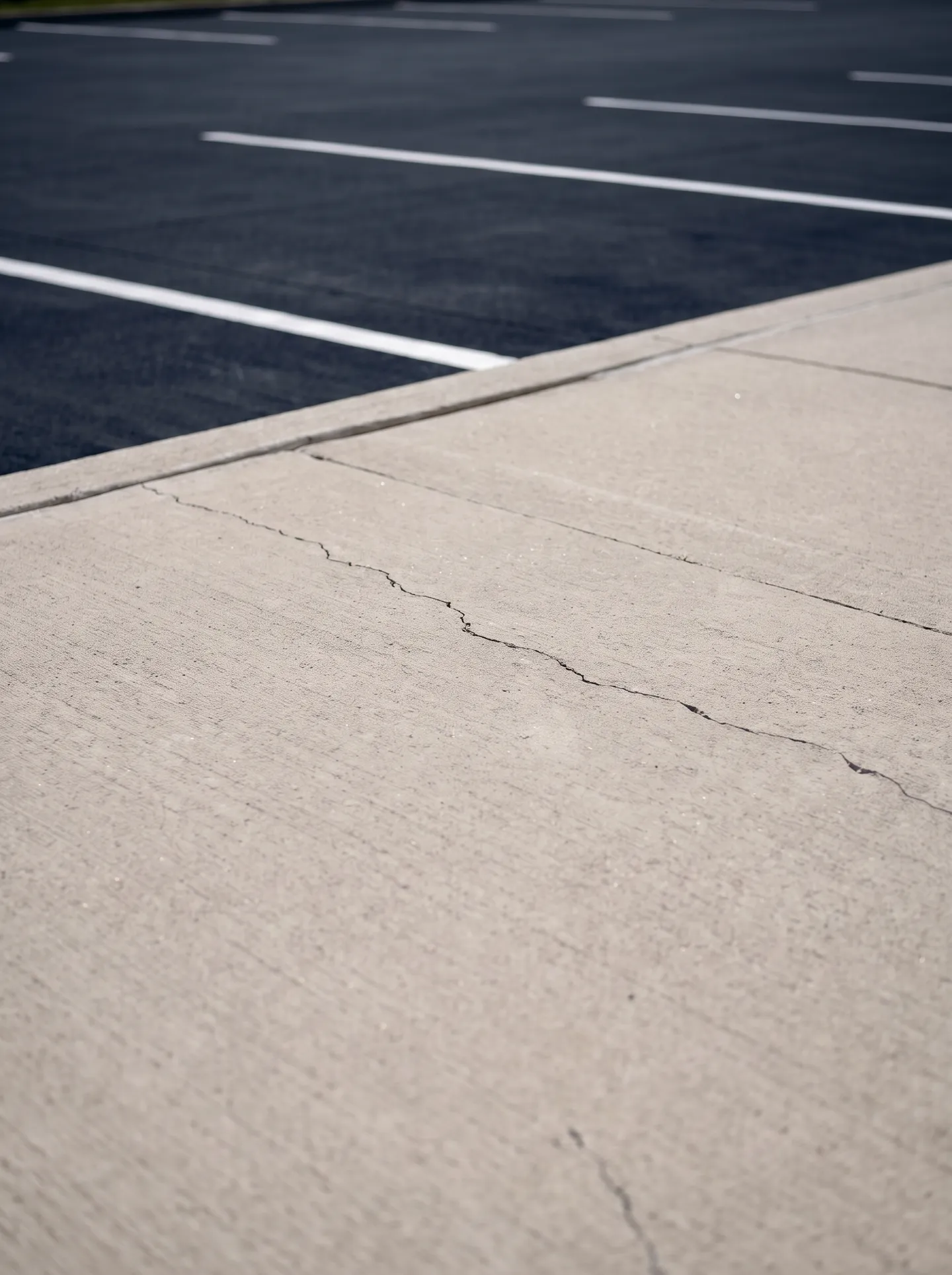
Trip Hazard Liability: When Do Concrete Sidewalk Cracks Need Commercial Repair?
A cracked sidewalk is easy to ignore until someone catches a toe on it. On commercial property an uneven walkway is two problems at once: a trip-and-fall liability and, more often than owners expect, an ADA violation. What matters is how far the surface has moved, because that is what turns a rough-looking crack into a real hazard.
When Does a Crack Become a Hazard?
- Vertical displacement: the ADA reads this in three bands. A change up to 1/4 inch may stand vertical, a change between 1/4 and 1/2 inch has to be beveled at a slope no steeper than 1:2, and anything over 1/2 inch has to be ramped. A raised or sunken slab edge past those limits is the classic trip hazard.
- Cross slope and width: an accessible route needs a 36-inch minimum clear width and a cross slope no steeper than 2%, so a slab that has tilted or pinched the path fails even without a lip to trip on.
- Spalling and loose material: a crumbling surface and loose fragments are both an immediate hazard and a signal the slab is coming apart.
Repair Options for Commercial Walkways
- Grinding or beveling: for a small vertical lip, grinding the high edge back down removes the hazard and restores the bevel.
- Slab leveling: where a slab has settled, lifting it back to grade treats the cause instead of chasing the symptom.
- Replacement: badly spalled or broken slabs come out and are re-poured to ADA geometry, and any curb ramp gets fresh detectable warnings, the bumpy truncated-dome pads that alert visually impaired pedestrians to the crossing.
We handle commercial walkways, curbs and ADA curb ramps under concrete sidewalks and curbs, and tie the fix back to ADA compliance for the lot as a whole. Request a concrete assessment.
The Two Kinds of Liability a Cracked Walkway Creates
An uneven commercial walkway exposes an owner on two fronts at once. The first is ordinary trip-and-fall. Under Florida premises law a business owes its customers, who count as invitees, the highest duty of care: keep the property reasonably safe and inspect it for hazards a visitor would not spot. A raised slab edge that catches a toe can put that duty squarely in play, and since the 2023 tort reform an injured person generally has two years from the fall to bring the claim. The second front is the ADA. A public accommodation has to keep its accessible routes usable, so a walkway that has heaved, tilted or crumbled past the ADA thresholds is a compliance problem whether or not anyone has tripped yet. This is general information rather than legal advice, and both exposures run at the same time.
Where Curb Ramps Come In
The walkway does not end at the curb, and neither does the ADA. Where a sidewalk meets a parking lot or street, a compliant curb ramp runs no steeper than 1:12, holds its cross slope to 1:48, and ends in a level landing at least 60 inches long. Flared sides may run up to 1:10, and any ramp with a rise over 6 inches needs handrails 34 to 38 inches high. At the base, detectable-warning truncated domes alert visually impaired pedestrians to the crossing. A cracked or settled ramp fails these the same way a cracked sidewalk does, and we rebuild it to that geometry.
How We Match the Repair to the Damage
The fix follows the measurement. We check the lip against the ADA bands first, because a displacement heading past the half-inch line is the one that has to come down or be ramped rather than simply flagged. A shallow lip grinds back to a compliant bevel in a single visit. A slab that has settled as a whole can be lifted back to grade, treating the cause rather than chasing the symptom year after year. A slab that is badly spalled or broken comes out and is re-poured to ADA geometry, with detectable warnings reset at any curb ramp. We tie each walkway fix back to the lot's overall ADA compliance so the accessible route works end to end.
Common Questions
- Exactly how much lip is allowed before it has to be fixed? The ADA sets three bands: up to 1/4 inch may stand vertical, 1/4 to 1/2 inch must be beveled at no steeper than 1:2, and anything over 1/2 inch has to be ramped. Past those limits an edge is both a barrier and a trip hazard.
- How long after a fall can someone sue in Florida? For a negligence claim that accrued on or after the 2023 tort reform, generally two years. Florida shortened the window from four years to two, so a documented repair history matters sooner than owners expect. This is general information, not legal advice.
- If the pedestrian was distracted, does that reduce my liability? It can. Florida now follows modified comparative negligence: a person found more than 50 percent at fault recovers nothing, and below that their damages are reduced by their share. It does not erase the duty to keep the walkway safe.
- Does the ADA threshold apply everywhere or only on accessible routes? The 1/4-inch threshold governs accessible routes and walking surfaces specifically, but the trip-and-fall duty covers the whole walkable property, so a hazard off the accessible route can still be a liability.
Related Guides
- Who Is Liable for Pothole Damage in a Commercial Lot?
- Central Florida ADA Parking Lot Compliance
- All resource guides